

Product Overview
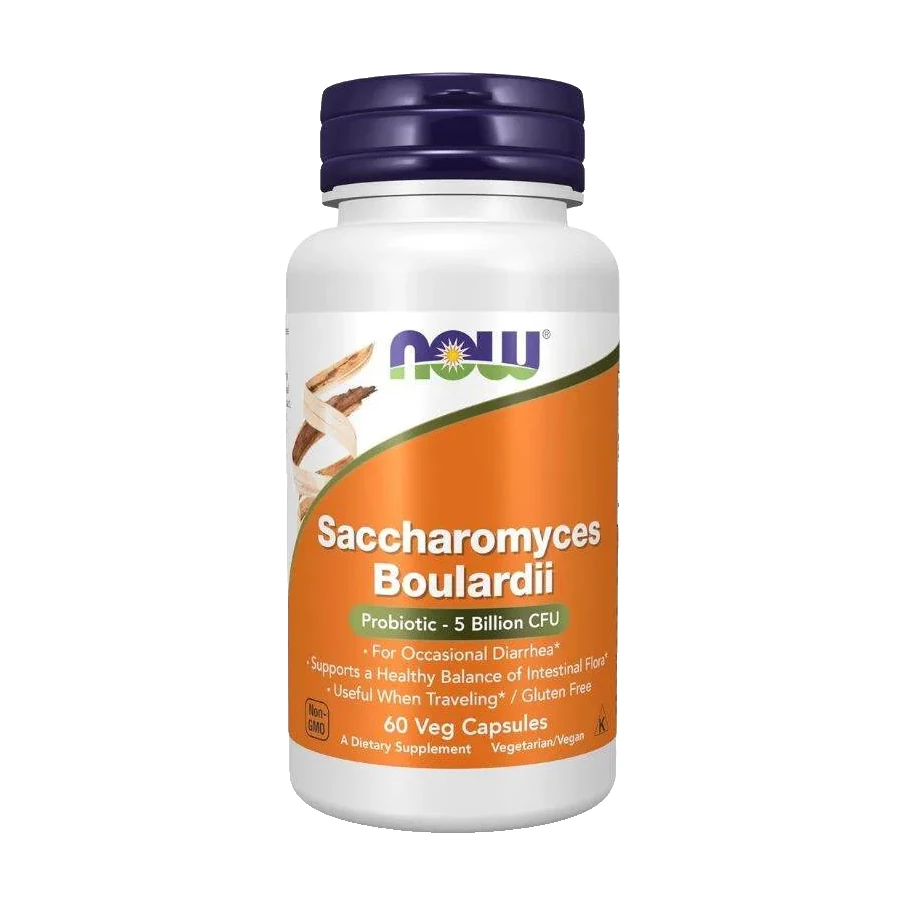
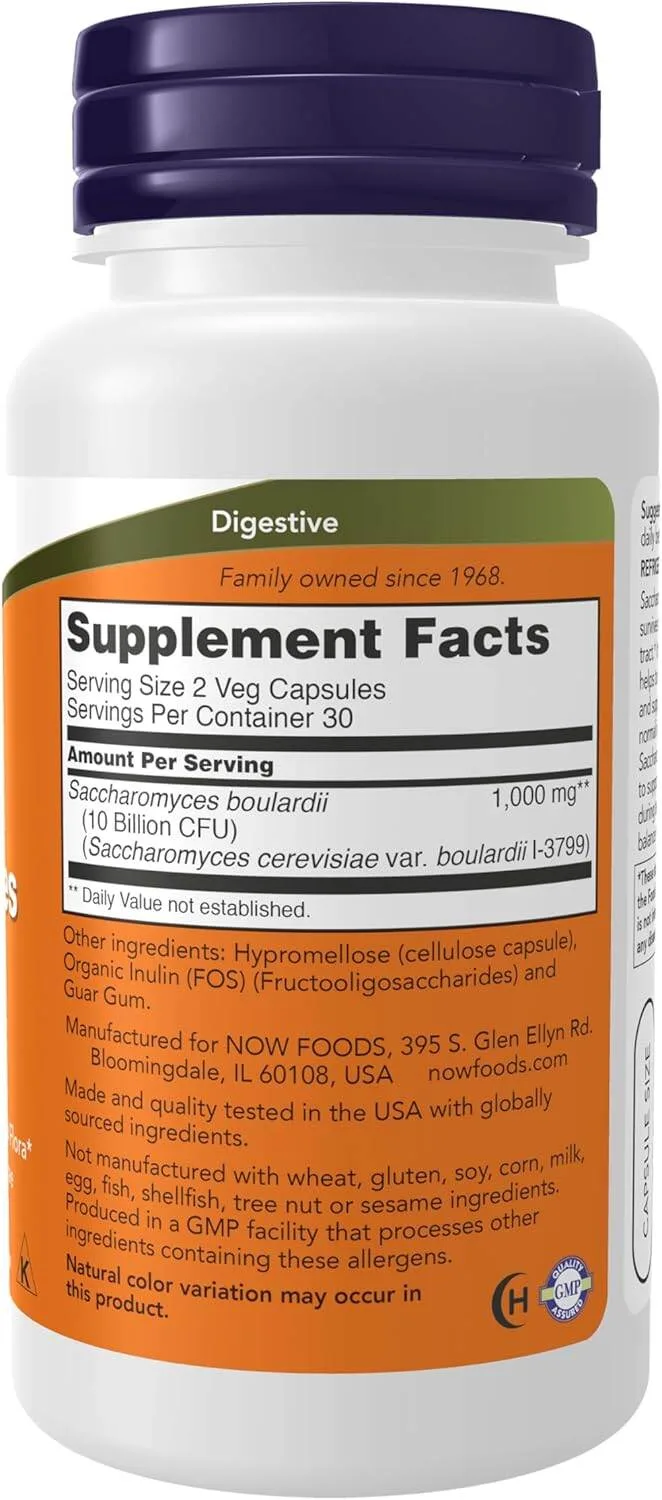
NOW Saccharomyces Boulardii is a probiotic yeast, not a bacterium. The supplement facts panel in the product photo gives 1,000mg — 10 billion CFU — per serving of 2 veg capsules, so 5 billion CFU per capsule, with 30 servings in a bottle of 60 capsules. The strain is listed as Saccharomyces cerevisiae var. boulardii I-3799.
The bottle is labelled vegetarian/vegan, non-GMO and gluten free, and the front reads “For occasional diarrhea”, “Supports a healthy balance of intestinal flora” and “Useful when traveling”. Manufactured for NOW Foods of Bloomingdale, Illinois, USA, and made and quality tested in the USA. The seller states it is shelf-stable and needs no refrigeration.
What Makes S. Boulardii Different
- It is a yeast, so it survives stomach acid well.
- Ordinary antibiotics do not kill it, because they target bacteria — which is why it is often taken during a course of antibiotics.
- Antifungal medicines do kill it — fluconazole, nystatin and similar. Taking them together wastes the probiotic.
Key Benefits
- Diarrhoea linked to antibiotics — this is the best-supported use. In trials, S. boulardii lowered the chance of getting diarrhoea during a course of antibiotics.
- Travellers’ diarrhoea — some studies show a modest benefit.
- Short bouts of diarrhoea — studies, mostly in children, show it can shorten them by about a day.
- Gut flora balance — it supports a normal balance of gut microbes.
Most research uses particular strains of S. boulardii; this bottle uses strain I-3799, so the evidence is a guide rather than a promise for this exact product.
Diarrhoea — What Matters Most
Oral rehydration solution (ORS) comes first. Dehydration is what makes diarrhoea dangerous, and ORS is what prevents it. A probiotic is an add-on, never a replacement.
See a doctor urgently for blood in the stool, a high fever, signs of dehydration (very little urine, dizziness, sunken eyes, extreme thirst), diarrhoea lasting more than two or three days, or diarrhoea in a small child or an elderly person.
Important — Who Should Not Take It
- A weakened immune system — chemotherapy, HIV, high-dose steroids, an organ transplant.
- A central line or serious illness in hospital — rare but serious bloodstream yeast infections have been reported in these patients, including from capsules opened nearby.
- Yeast allergy.
- Antifungal medicine — it will not work alongside it.
Key Features
- 5 billion CFU per capsule; 10 billion CFU per 2-capsule serving
- 60 veg capsules — 30 servings
- With organic inulin (FOS), a prebiotic fibre
- Vegetarian and vegan; gluten free; non-GMO
- Shelf-stable, as stated by the seller
Ingredients / Specifications
Per serving of 2 veg capsules (from the label photo): Saccharomyces boulardii 1,000mg (10 billion CFU) — Saccharomyces cerevisiae var. boulardii I-3799.
Other ingredients: hypromellose (cellulose capsule), organic inulin (FOS, fructooligosaccharides) and guar gum.
The label states it is not made with wheat, gluten, soy, corn, milk, egg, fish, shellfish, tree nut or sesame ingredients, but is produced in a GMP facility that processes other ingredients containing these allergens.
How to Use
- The panel gives a serving of 2 capsules. The full directions are on the side of the bottle and not legible in the photos — follow them.
- With antibiotics, start with the course and continue for a few days after it ends, if your doctor agrees.
- Do not take it with antifungal medicine.
Who Is It Suitable For?
Healthy adults taking antibiotics, travelling, or wanting a probiotic that is not affected by antibiotics. Vegetarians and vegans, by the label.
- See “Who Should Not Take It” above.
- Children — only on a doctor’s advice.
- Pregnancy and breastfeeding — ask your doctor.
Why Choose NOW Saccharomyces Boulardii?
A well-studied probiotic yeast from an established US maker, with a short ingredient list and no refrigeration needed — practical in Dhaka and for travel.
This Is a Supplement, Not a Medicine
A dietary supplement is a food product. It is not a medicine, it has not been through the testing a medicine goes through, and it does not diagnose, treat, cure or prevent any disease.
Supplement labels use health language — “supports”, “helps maintain”, “promotes” — precisely because they are not permitted to claim treatment. Read them that way. If a listing anywhere promises that a capsule will fix a medical condition, that promise is not one the product can keep.
What a supplement can honestly do is fill a gap in your diet. That is worth something, and it is a smaller thing than most packaging implies.
Talk to a Doctor First
Speak to a doctor or pharmacist before you start, particularly if you:
- take any prescribed medicine — supplements interfere with medicines more often than people expect
- are being treated for a heart, liver, kidney, thyroid or blood condition
- have diabetes
- are pregnant, trying to conceive, or breastfeeding
- have surgery or a dental procedure coming up
Never stop or reduce a prescribed medicine in order to take a supplement instead. That is the single most dangerous thing anyone does with a product like this, and it is what the marketing language quietly invites.
About the Imported Pack
This is an imported product. The label, the dose instructions and the ingredient panel are the ones printed for the market it was made for, and the wording may differ from a locally packaged version.
Follow the dose printed on the pack itself — it is the authority on its own contents — and check the expiry date when it arrives. If anything on the label is unclear, message us before you take it and we will read it to you.
Storage
- Keep the container tightly closed, somewhere cool and dry, out of direct sunlight.
- Do not store it in a bathroom. Heat and humidity break supplements down faster than anything else, and a Dhaka bathroom is the worst place in the house for them.
- Leave the desiccant sachet in the bottle. It is there to keep moisture out, not by mistake.
- Softgels and fish oils are best kept in a fridge in hot weather — they go rancid otherwise.
- Keep it out of reach of children.
- Do not use it after the expiry date, and throw it away if the capsules smell strongly off, have stuck together or changed colour.
Frequently Asked Questions
Can I take it with antibiotics?
Yes — that is one of its main uses. Antibiotics do not kill it because it is a yeast. Antifungal medicines do.
Will it stop diarrhoea?
It may shorten it slightly. ORS is what matters most, and some kinds of diarrhoea need a doctor — see the warning signs above.
Does it need to be kept in the fridge?
The seller says no. In Dhaka summer heat, a cool, dry cupboard is the minimum.
How long before I notice anything?
Honestly: with most supplements, you do not notice anything, because filling a nutritional gap feels like nothing. Where there is a measurable effect it usually takes weeks to months. Be sceptical of anything you feel within a day or two.
How do I check the pack is in date?
The expiry date is printed on the bottle or the base of the box. Check it as soon as your order arrives. If it is unreadable or close to expiry, message us and we will replace it.






Reviews
There are no reviews yet.